
Is a Smart Watch Worth It in 2026? The truth
Is a smartwatch worth it in 2026? I give you the frank analysis: hidden costs, who it is for and who it is wasted money for. No filter.


TL;DR
Yes, it is worth it if you already use a smartphone and want to monitor health or notifications without taking out your cell phone every two minutes, but not if you expect it to replace a mechanical watch or last for years without degrading.
What real problem does a smartwatch solve in 2026?
The real problem isn't "knowing the time." Any cheap Casio digital watch (check current price) handles that for a lifetime and can survive a fall from a second-story window without complaint. What a smartwatch actually solves is the friction of pulling your phone out fifty times a day to check a notification that, 90% of the time, doesn't even deserve a reply. That whole ritual — reach into your pocket, unlock, read, put it away — adds up fast. Smartphone usage studies clock the average person checking their phone more than 90 times a day. A watch on your wrist filters that noise: a quick glance tells you if it's a food delivery app spamming you or your boss actually needs something, and you decide from there whether the phone is worth digging out.
The second real problem — and honestly, the one that justifies the purchase the most in 2026 — is passive health tracking. I'm not saying the watch diagnoses anything (it's not a medical device, no matter what the box implies). What it gives you is consistent trend data: resting heart rate, heart rate variability, sleep, steps, blood oxygen. I've worn one daily for three years, and the data point that actually changed my habits wasn't some dramatic alert — it was watching my deep sleep drop from 1.5 hours to 40 minutes during weeks when I drank coffee after 3pm. That kind of quiet correlation is gold, and no mechanical watch on Earth is going to hand you that, no matter how pretty the automatic movement looks through the case back.
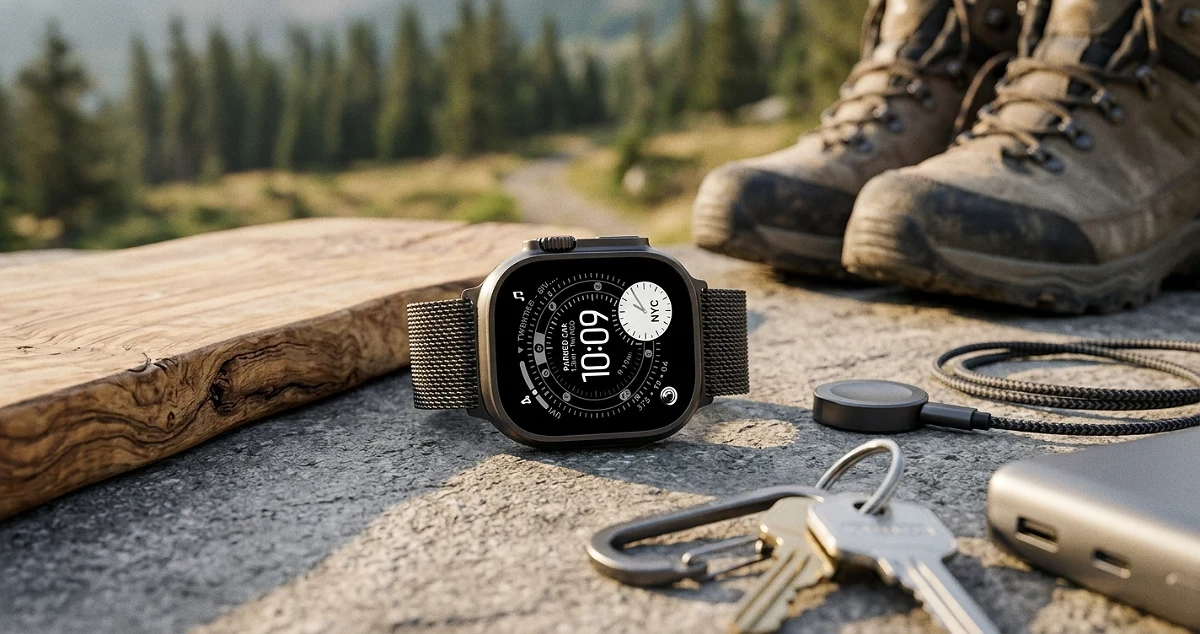
Third problem, more niche but still real: training with actual data. If you run, swim, or bike, a watch with multi-band GPS and a decent optical heart rate sensor (not the cheap kind that mistakes a pothole jolt for your pulse) gives you real training zones. Translated to daily life, that means being able to train on a mountain trail or run a local loop and know your heart rate without strapping on a separate chest band — because that's just one more gadget you have to keep charged (in the electrical sense too).
What it does NOT solve, and here's where the skepticism kicks in: it won't cure boredom, it won't make you more productive on its own, and it definitely doesn't replace the mechanical satisfaction of a well-built automatic watch. If that's what you're after, you're in the wrong aisle.
The hidden cost nobody mentions: the battery isn't forever
Here's the thing launch reviews almost never tell you, because they're testing the watch fresh out of the box, not the watch two years in. The lithium batteries in these things degrade with charge cycles, same as any phone battery. A watch that shipped with 18 hours of full smartwatch-mode battery life will, after 400-500 charge cycles (roughly a year and a half to two years of daily use), often be down to 60-70% of that original runtime. In plain English: the watch you used to charge once a day now needs two charges, or it dies on you mid-afternoon right when you need it most — like halfway through a 10K.
This isn't a manufacturing defect. It's just lithium-ion physics, the same degradation curve your phone battery goes through. The difference is it's way more noticeable on a watch, because the battery is tiny to begin with (think the gap between a 5000mAh phone battery and the 300-450mAh cells typical in a smartwatch), so any capacity loss hits proportionally harder.
The second hidden cost is battery replacement itself. Unlike a quartz watch, where you swap the cell for pocket change at any corner watch shop, smartwatch batteries usually come soldered or sealed inside the case, and replacement — if the manufacturer even offers it, which isn't a given — can run you a significant chunk of what a new watch costs. Plenty of brands don't offer the service at all, which in practice makes the watch disposable electronics with a built-in expiration date: 2-3 years of full performance, then it's all downhill.
Third hidden cost: software obsolescence. Brands like Apple and Samsung typically deliver 4-5 years of updates, but a lot of mid-range and budget brands stop updating the OS after 2 years, which means third-party apps start breaking or vanish from the compatible app store entirely. It's the smartwatch equivalent of buying a phone that stops getting new apps — it still works, but it gets more cut off from the ecosystem every year.
My practical advice: if you're going to invest in a smartwatch, budget for it mentally as a recurring expense every 2-3 years, not a lifetime purchase the way a well-maintained mechanical watch can be — the kind you actually pass down.
Who Should Actually Buy One
No question about it: this makes sense if you're already living in the smartphone ecosystem and want to cut down on notification fatigue. If you're the type who checks their phone constantly out of social or work anxiety, a watch buys you some peace of mind. You filter on your wrist and only pull out the phone when it actually matters. That benefit alone, measured in minutes of attention you get back every day, justifies the purchase for a lot of people.
It's also worth it if you train seriously, even at an amateur level. Running, swimming, cycling with real heart rate and GPS data helps you train smart instead of just going by feel. The key here is don't buy the bottom-tier model. If training is your main reason for buying, spend up for a mid-to-high tier with real multi-band GPS, because a cheap optical sensor tends to choke exactly when you need it most — during that final sprint.
It's worth it for anyone who wants passive health tracking without turning it into an obsession: sleep, steps, resting heart rate. This is especially useful for people over 40 who are starting to pay attention to those numbers, or for anyone managing a condition where the trend — not a diagnosis — matters, always under real medical supervision, not the watch's.
It's NOT worth it if you're chasing status or want a watch that lasts a lifetime as a family heirloom. It's NOT worth it if you hate charging devices (you've already got the phone, the power bank, and the earbuds to worry about). And it's definitely not worth it if your budget is tight and you're expecting a one-time purchase — go in knowing that in 2-3 years you'll be eyeing the next model, same as with your phone.
Who's Wasting Their Money
Let me be blunt: if you want a watch that runs for fifteen years without a charge and gets handed down to your grandkid, a smartwatch is the worst investment on the table. A mechanical Seiko runs on pure physics — no firmware, no updates that brick it down the line. A smartwatch, on the other hand, comes with a built-in expiration date: battery that degrades, software that eventually loses support, and a manufacturer app that one day decides your 2023 model is no longer "a priority." That's not a bug. That's the business model.
It's also not for anyone who hates charging devices. If you already dread plugging in your phone every night, adding a second gadget with its own cable (almost never the same port, of course) doubles your mental load — literally. I know people who bought their smartwatch full of excitement and three months later it's sitting in a drawer because they forgot to charge it two nights in a row and went back to their old wind-up watch. Here's the number that matters: a smartwatch you don't charge is just an expensive bracelet that does nothing.
Another "wasted money" profile: anyone hoping to replace their phone with it. You can't. Not even the most premium smartwatch on the market lets you write a long email, binge a show, or do a decent video call. It's a satellite orbiting your phone, not a replacement for it. If your expectation is "I won't have to carry my phone anymore," you'll be disappointed fast — without the phone nearby, a lot of features (notifications, precise GPS, certain apps) just don't work the same.
And the most common case here in Venezuela: buying one for the gym you hit twice a month. If your activity is sporadic, you end up paying (or asking someone to bring it back for you) for a heart rate sensor you use less than your grandmother's rice cooker. In that case, a basic fitness watch — or honestly just your own memory — does the exact same job, minus the anxiety of watching the battery drop to 12%.
What's Actually Gotten Better in the Last Two Years
Let's give credit where it's due, because the jump from 2024 to 2026 isn't just cosmetic. Battery life on mid-range and premium models went from "a day and a half if you're lucky" to real-world ranges of three to seven days with the AMOLED screen on and GPS active under moderate use. That changes the whole experience — you're no longer living with charger-in-the-backpack anxiety like it's a vital organ.
Health sensors took a leap you actually notice in daily use. Blood oxygen (SpO2) readings are more stable, skin temperature sensors now come standard on more models, and atrial fibrillation detection — once locked to a couple of premium brands — is trickling down into mid-range. In plain terms: what used to be a luxury feature now shows up on watches at a more accessible price point.
Ecosystem integration got noticeably better too. Pairing an Android watch with full functionality used to be a coin flip; now most major brands — Samsung, Google, Garmin, Amazfit — have much smoother cross-compatibility. Even if you're on iPhone, there are more options than before that work decently well, though Apple Watch still wins there for obvious home-turf reasons.
Displays evolved as well: outdoor brightness is far more readable under harsh sun (something we appreciate here in Venezuela, since a watch that turns into a black mirror at noon is a useless paperweight), and water/dust resistance (5ATM or IP68 ratings) is now standard even on budget models, not just flagship tiers.
And the onboard "AI" chip — yes, pretty much every brand brags about "AI" now even though it's basically pattern analysis — gives sleep and recovery recommendations that are closer to reality than before. It used to just tell you "sleep more" as its one-size-fits-all suggestion; now it cross-references heart rate variability, temperature, and movement for something more useful. Still, don't put it on a pedestal — it's an algorithm, not a cardiologist.
The Myth of Medical-Grade Accuracy: What It Actually Tracks Well (and What It Doesn't)
Time for a reality check, because the marketing pitch makes these watches sound like a clinical lab strapped to your wrist. That's half true at best. What it genuinely nails is resting heart rate and steady-state exercise — jogging, walking, spin class. The optical sensor gets a clean, stable signal in those conditions, so the numbers come out close to what you'd get from a chest strap monitor.
Step counting is surprisingly accurate on flat ground at a normal pace. Sleep tracking is shakier: it's good at figuring out when you fell asleep and woke up, but deep sleep and REM stages are estimates built from movement and heart rate, not actual brain waves. Translation: it's an educated guess, not a hospital-grade sleep study.
Where the myth falls apart completely is SpO2 and ECG. These are early-warning tools — if your watch flags something weird more than once, go see a doctor — but they're not a diagnosis. The FDA and similar agencies approve these features as "informational," never as a replacement for a real clinical exam. I've watched people spiral into panic over an arrhythmia notification that turned out to be a loose watch band picking up motion noise and mistaking it for an irregular pulse. The detail nobody tells you: how the watch sits on your wrist affects the reading way more than people assume.
Calorie burn tracking is, without exaggeration, the least trustworthy number on the whole device. It's built from generic formulas using weight, height, and heart rate, with zero regard for your actual body composition. If you're using that number to plan your diet down to the gram, you're building a house on sand.
Verdict on the medical accuracy question? Great as a trend indicator — "my resting heart rate crept up this week, something's off" — useless as a final diagnosis. Treat it like an assistant that tells you when to pay attention, never like the doctor replacing your checkup.
Smartwatch vs. Traditional Watch: The Honest Comparison
Let's start with something no salesperson will tell you: a smartwatch and a traditional watch aren't even playing the same sport. It's like comparing a Swiss Army knife to a chef's knife. The chef's knife cuts better, full stop. But the Swiss Army knife bails you out in twenty situations where the chef's knife is sitting useless in a drawer. A solid mid-range Seiko mechanical will keep time within seconds of accuracy for decades, no battery, no software updates, no screen to scratch up. An Apple Watch or Galaxy Watch will tell you the time too, but it'll also throw in a living-room ECG, your step count, your texts, and a buzz on your wrist when your boss messages you at 11 p.m. (blessing or curse, depending on the day).
Here's the detail that actually matters: a good mechanical watch measures its accuracy in seconds per day. A smartwatch's accuracy depends on it syncing with your phone and some server in the cloud. Battery dies or you lose signal, and your "smartwatch" turns into an expensive black-screened paperweight. Happened to me standing in line at the bank: watch dead, phone at 2%, and I ended up asking a stranger for the time like it was 1998.
Where the smartwatch wins by a mile is contextual info on the fly. You see who's calling without pulling out your phone, check your heart rate after climbing a flight of stairs, and on GPS-equipped models (premium tier territory) you can go for a run without your phone and still get a full route track. A traditional watch, no matter how sharp it looks, just can't do that. No Rolex is going to ping you about weird blood pressure readings.
Where the traditional watch wins is something we underrate: the feeling of owning a permanent object. A well-maintained mechanical watch gets passed down. A three-generation-old smartwatch stops getting software updates and its health app starts treating it like a second-class citizen. I bought my first smartwatch thinking it'd last "for life," and two years later the manufacturer dropped support entirely. My grandfather still wears the watch he got at his graduation. That's the real philosophical split: one's consumer electronics, the other's an instrument.
Bottom line: if status and longevity are your priority, go traditional watch. If digital integration and health tracking are your priority, go smartwatch. What doesn't work is expecting either one to do the other's job. And honestly, a lot of people end up running both — the smartwatch for the gym and notifications during the week, the mechanical for the dinner where nobody wants to catch you checking email on your wrist.
How Long Before You Actually Have to Replace It?
Here's the part that never makes it onto the box: a smartwatch has an expiration date, and it's not a figure of speech. The lithium battery inside starts degrading from day one, same as your phone's. On budget and mid-range models, after 18 to 24 months of daily use you'll notice the charge that used to last two days now barely makes it through one. The watch isn't broken — that's just lithium-ion battery chemistry doing its thing. As predictable as ice melting in the sun.
The second factor is software support. The big names — Apple, Samsung, Garmin — typically deliver 3 to 5 years of OS updates. After that, the watch still runs, but it stops getting improvements, some third-party apps drop compatibility, and in the worst case the manufacturer just shuts off the cloud servers powering certain features. I had a watch from a lesser-known brand where, two years in, the maps feature just vanished because they killed the service. No warning, no notice. Worked one day, gone the next.
The third factor, and the one people most underestimate, is physical wear: the screen picks up scratches with daily use (especially without sapphire crystal, which is strictly a premium-tier feature), the silicone band cracks from sweat and sun exposure after a year or two, and the heart rate sensor can lose accuracy if the watch takes regular knocks. In a hot, humid climate, that silicone band wears out a lot faster than it would somewhere temperate. It's a detail almost nobody factors in before buying.
So how long does it actually last? My rule of thumb, built from years of testing these things: budget tier, 1 to 2 years of solid performance before the battery and software start slipping. Mid-range, 2 to 3 years. Premium tier with strong manufacturer support, 3 to 5 years, and you can stretch that further by just swapping the band. No smartwatch, not even the priciest one, is going to run like new for a full decade. If someone tells you otherwise, either they haven't owned one that long, or they're trying to sell you something.
My verdict after years of testing these things
After rotating through a bunch of models — budget, mid-range, and a premium one somebody lent me to try — my conclusion is simple, no sugar-coating: yes, it's worth it, but only with the right expectations. If you're already glued to your phone, if you're tired of pulling it out every two minutes to see who texted you, and if you want basic health tracking (steps, sleep, heart rate), a smartwatch will genuinely make your life easier in ways you can measure. That's not hype, that's just convenience — the kind you don't notice until you have it, and then you can't imagine going back.
What you should NOT expect is a watch for life, or something that replaces the feel and prestige of a well-made mechanical watch. Don't expect it to hold up without degrading, either: the battery will wear down, the software will eventually fall behind, and at some point you'll have to decide whether to buy a new one or go back to a bare wrist. This is consumer tech with a defined shelf life, same as a phone. Accepting that up front saves you the letdown of feeling ripped off when the thing simply did what every gadget eventually does: get old.
My practical advice: if it's your first smartwatch, start in the mid-range tier. That's where you get the best balance of useful features (GPS, notifications, basic health tracking, decent water resistance) and reasonable durability, without overpaying for premium sensors you'll probably never use to their full potential. If you're a serious athlete or need advanced training metrics, that's when stepping up to premium actually makes sense. And if all you want is to tell time in style for a special occasion, skip the software-update headache and get yourself a nice traditional watch instead. There's no shame in owning both — each one earning its keep. At the end of the day, the best watch is the one that fits how you live, not the one with the longest spec sheet.
My final verdict
I'll give it to you straight: a smartwatch in 2026 is worth buying, but only if you understand exactly what you're getting. It's not a piece of jewelry you hand down to your grandkid — it's a gadget with an expiration date. The battery degrades, the software eventually stops keeping up, and in three or four years you'll want the newer model the same way you want the newer phone. That's not a hidden flaw. That's just what this product is.
What actually matters is how you use it day to day: if you're already glued to your phone and every notification sends you digging through your pocket a hundred times a day, the watch cuts out that whole ritual. Add in sleep tracking, heart rate, and step counts without strapping on a separate device, and it wins easily. But if what you want is something that'll still look sharp in forty years and only needs a battery swap every couple, buy a mechanical watch and skip the charger drama entirely.
Would I buy one? Yes — knowing exactly what it's for and what it isn't. It's a convenience tool, not a lifetime investment. Once you're clear on that deal, go ahead: check out our hand-picked lineup of smartwatches in the BaratongoVzla catalog and pick the one that fits your routine, not your ego.
Reference estimate based on typical battery cycles and software support, not a manufacturer guarantee.
- Notifications35 %35%
- Health/activity tracking30 %30%
- Time and style20 %20%
- Payments and extra features15 %15%
Reference estimate based on common usage patterns reported by users, not our own survey.
Deals before anyone else
Want a heads-up when prices drop?
Drop your email and we'll send the tech deals and the gadgets going viral — no spam, just the good stuff.
Frequently asked questions
No. It complements, it does not replace. You can answer notifications and in some cases calls, but to write a long message or watch a video you still need the phone. It is a wrist assistant, not a substitute.
Our picks from this guide

Rolex President 6927 26mm Bark Dial Oro
Best for: Collectors and vintage lovers looking for a Rolex with history, unique texture, and quiet elegance that doesn't need to shout 'look at my watch.'
A solid gold watch with a 'bark' finish (textured like tree bark) that's aged better than most of our relationships, plus a linen dial that gives it that discreet 'yes, it's gold, but I'm not screaming about it' vibe.

Citizen Eco-Drive Pilot Chronograph
Best for: For anyone who wants a serious, precise pilot watch without the eternal jeweler visits to swap the battery.
A watch that charges off light and never needs a battery, so technically it survives on air and sunshine like a very fancy houseplant; it also self-adjusts via atomic signal, more punctual than anyone you know.

Garmin fēnix 8 Pro (51mm, MicroLED, Zafiro)
Best for: Serious athletes and outdoor enthusiasts who want the best Garmin has, budget be damned.
This watch is so loaded it probably knows more about your body than your doctor does, and the MicroLED display makes the sun tap out in defeat.
From our store
Tested, verified products — ready to ship.




Ready to upgrade your setup?
Browse the gadgets we actually tested and stand behind.